


Foreign companies evaluating Türkiye often begin with the wrong question: “Where should we register the company?” The useful question is what the Turkish operation must actually do. Domestic sales, export manufacturing, assembly, warehousing and regional business development require different structures. İzmir becomes strategically interesting only after that operating model is clear.
Istanbul is the obvious reference point for finance and headquarters. İzmir follows a different logic: production depth, port and airport access, an established Aegean industrial network and a business culture shaped by exports. The Aegean Free Zone operated by ESBAŞ in Gaziemir is therefore relevant not to every investor, but to companies trying to combine production and international trade in one platform.
The scale behind the ESBAŞ proposition
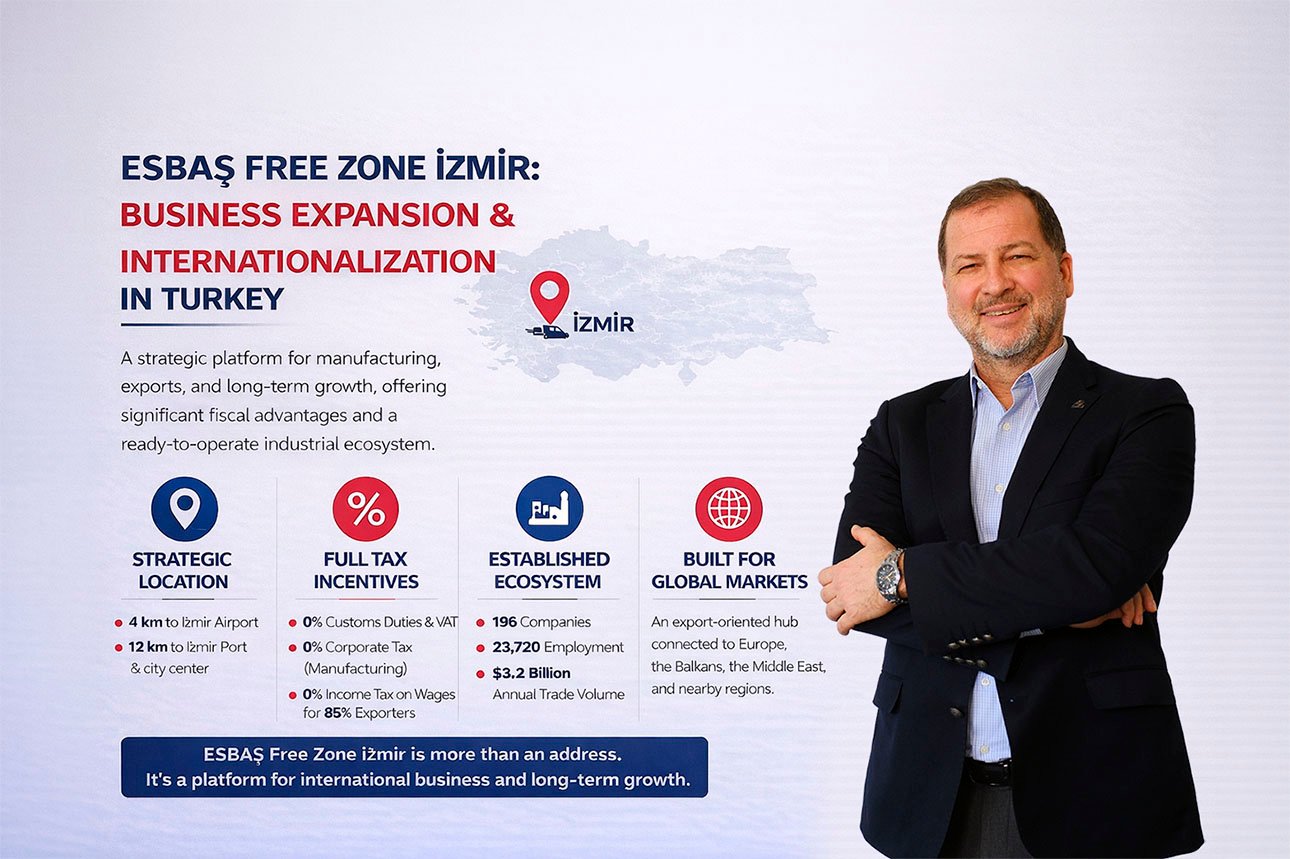
Figures reported in Mauro Benigno’s April 2026 interview with ESBAŞ Investment Coordination Director Murat Özgürtaş describe an ecosystem of 196 companies, around 23,720 jobs and approximately US$3.2 billion in trade volume. The manufacturing-focused zone covers roughly 620 acres and is positioned about 4 km from İzmir Adnan Menderes Airport and about 12 km from the port/city-centre direction. The practical significance is not the headline size alone: a new investor enters an environment where customs, production services and export routines are already part of daily operations.
| Operating model | Potential ESBAŞ value | Main caution |
|---|---|---|
| Export manufacturing | Customs/VAT efficiency and incentives available to qualifying manufacturers | Export ratios, licensing and eligibility conditions |
| Assembly and re-export | Imported inputs can be organised within a trade-oriented structure | Correct classification of goods and activities |
| Warehousing and regional coordination | Access to European, Balkan and nearby routes | Tax treatment may differ from manufacturing |
| Sales mainly into Türkiye | Often a mixed or less efficient case | Movement from the free zone into Türkiye is treated as import |
| Small consulting or representative office | Usually limited advantage | A standard city company may be simpler |
Incentives are an eligibility test, not a slogan
Türkiye’s official free-zone framework can provide customs-duty and VAT exemptions, corporate income-tax advantages for manufacturing companies and wage income-tax exemptions for eligible manufacturers meeting export conditions. None of this means that every company with a free-zone address pays no tax. Activity type, manufacturing status, export ratio, licence scope and the direction of goods flows must be analysed together.
Before deciding, model a standard Turkish company and a free-zone structure side by side. Include rent and infrastructure, staffing, customs brokerage, stock financing, VAT on imported inputs, the share of domestic Turkish sales, expected exports and working-capital speed. A large theoretical tax benefit can be neutralised if the operation does not fit free-zone logic.
Who should seriously consider ESBAŞ?
- European manufacturers pursuing nearshoring and shorter supply chains
- Exporters of machinery, components, electronics, technical products or intermediate goods
- Groups seeking a base between Türkiye, Europe, the Balkans, the Middle East and CIS markets
- Businesses combining imported inputs with production, assembly or re-export
- Investors building long-term industrial capacity rather than a minimal sales presence
A company focused mainly on Turkish domestic sales, with low export volume or only a representative-office need may be better served by a standard limited or joint-stock company.
Eight questions to answer before the investment meeting
- What share of revenue should come from exports in year three?
- Which goods enter the zone and which will be sold into Türkiye?
- Are production, assembly, storage and trading all genuinely required?
- What percentage of cost comes from imported inputs?
- Which route matters most: port, air freight or road?
- How much space and how many employees are needed?
- Who owns quality, certification and customs responsibility?
- What is the realistic licensing, fit-out and working-capital budget?
Without these answers, an investor meeting tends to become a collection of incentive brochures. With them, ESBAŞ management, tax advisers, customs specialists and lawyers can work from the same financial model.
Expert analysis
This is an independent OnlineIzmir overview written for the city’s international business section; it does not reproduce the source article. For the full interview, current scale figures and the broader free-zone strategy, read Mauro Benigno’s ESBAŞ Free Zone İzmir: Business Expansion and Internationalization in Turkey.
OnlineIzmir view: İzmir is not valuable merely as a calmer or cheaper alternative. For the right company it can combine production, exports and regional coordination in one operating architecture. For the wrong company a free zone only adds complexity. The decision should follow a three-year operating model, not a city image.