


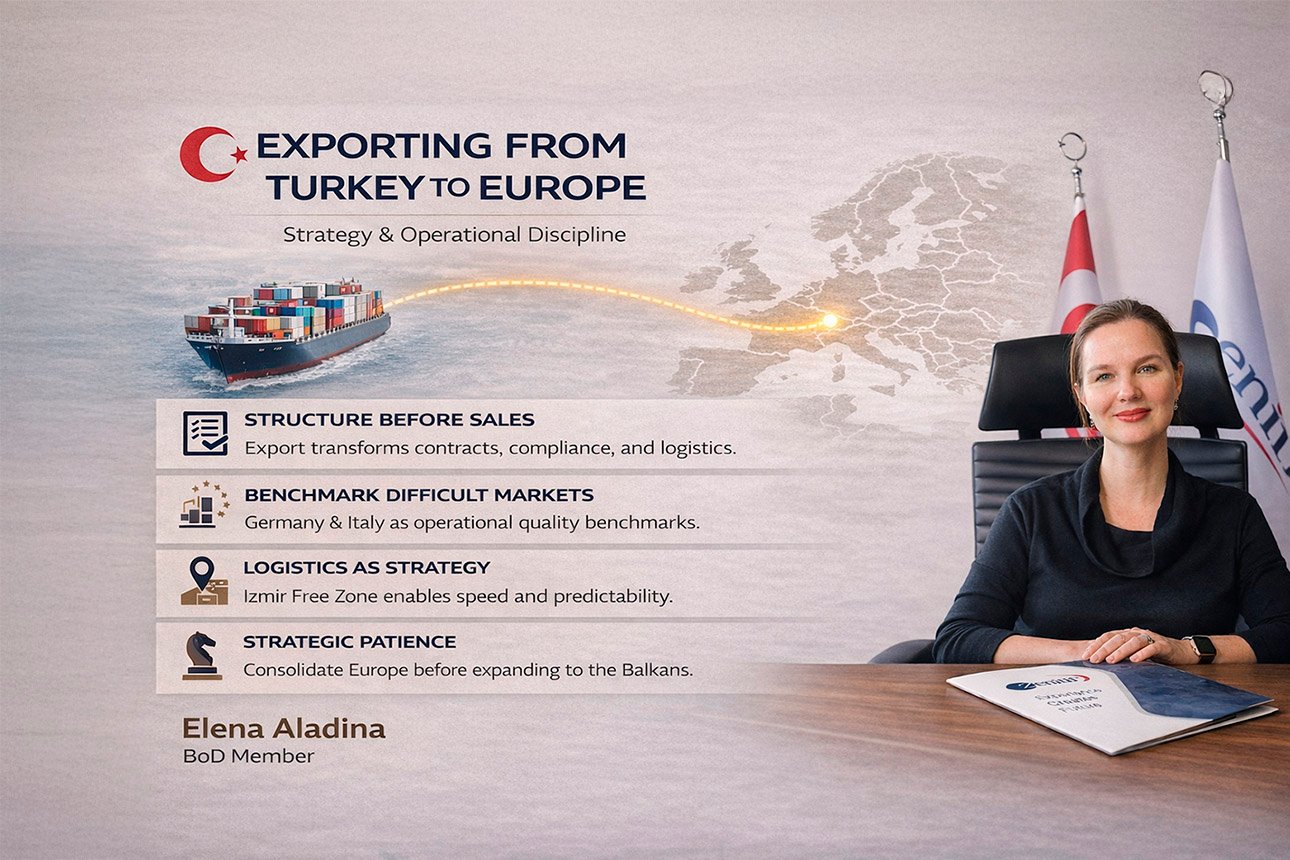
Many export projects begin when a sales team finds an interested European distributor. That is often too late to discover that product compliance, documentation, pricing, logistics and contractual responsibility were never designed as one system. Without that preparation, exporting creates recurring emergencies rather than growth. İzmir’s manufacturing and logistics advantages matter only when the company can deliver the predictability European buyers expect.
Mauro Benigno’s interview with Zenith İzmir board member Elena Aladina illustrates the point. Strong production capacity may open a conversation, but technical documentation, traceability, on-time delivery, after-sales support and engineering discipline determine whether a supplier remains in the European chain.
Measure readiness through eight working files
| File | Evidence of readiness | Weak signal |
|---|---|---|
| Product compliance | Applicable legislation/standards, tests and technical file | “We will obtain CE later” |
| Technical offer | Drawings, tolerances, materials, performance and approval route | Catalogue and price list only |
| Pricing model | Currency, raw material, packaging, warranty and freight scenarios | One price copied from a competitor |
| Contract | Incoterms, liability, quality, delay and warranty clauses | Treating the purchase-order email as a contract |
| Logistics | Transit time, backup carrier, damage and customs plan | Dependence on one forwarder |
| Capacity | Approved capacity and peak-period plan | Selling all normal capacity in the first order |
| After-sales | Complaint, spare-parts and corrective-action process | Assuming problems will not occur |
| Distributor | Verified territory, customer base, team and targets | Giving exclusivity to the first interested company |
European buyers purchase risk reduction, not only the product
A professional buyer asks whether the same quality, technical data and delivery date will be available on the tenth order. Your offer should therefore state tolerances, testing method, quality gates, delivery capacity, packaging and warranty responsibility—not only product benefits.
Another common mistake is making low price the entire value proposition. Price can open the first meeting; documentation and reliability win approved-supplier status. Protecting the price advantage also requires an adjustment model for currency, energy, metals or plastics and freight rather than a fixed quotation that becomes unprofitable after three months.
When choosing a distributor, you are buying a channel—not a country
A company operating in Germany is not automatically a capable German distributor. Verify the customer segment it reaches, whether its salespeople understand the product, its technical-service capacity, willingness to hold stock and relationships with competing brands. In the first year, performance-based exclusivity for a defined region or sector is usually safer than granting the entire country.
- Verify three customer references from the last two years.
- Ask for the number of sales and technical staff.
- Request a first-year account list and activity plan.
- Link exclusivity to revenue, stock and reporting conditions.
- Define ownership of the brand, customer data and post-contract relationships.
A realistic 12-week preparation plan
Weeks 1–3: gap analysis
Select the target country and buyer type; review applicable product rules, existing tests, the technical file and the pricing structure. “Europe” is not one market: a German technical wholesaler and an Italian project distributor may expect different evidence and service.
Weeks 4–6: sales and compliance package
Prepare an English technical quotation template, product sheets, conformity evidence, label and packaging sample, warranty terms and a sample-approval procedure. Keep marketing translation separate from technical translation.
Weeks 7–9: logistics and contract test
Model two transport routes, Incoterms impact, insurance, lead time and return/damage procedure. Calculate the pilot order after it reaches the customer, not when it leaves the factory.
Weeks 10–12: controlled market contact
Select 20–30 qualified buyers and adapt the approach to each segment. The first objective is not the largest order; it is a technical conversation and pilot that test your assumptions with limited risk.
Expert analysis
This guide is an independent OnlineIzmir implementation article. For the Zenith İzmir case, the interview and a fuller discussion of European market entry, read Mauro Benigno’s Exporting from Turkey to Europe: Market Entry Strategy for Turkish Manufacturers.
OnlineIzmir view: Exporting to Europe is not an extra sales channel. It is an upgrade to the company’s operating standard. Manufacturers that complete the invisible work before the first order move beyond price competition and become reliable suppliers.