


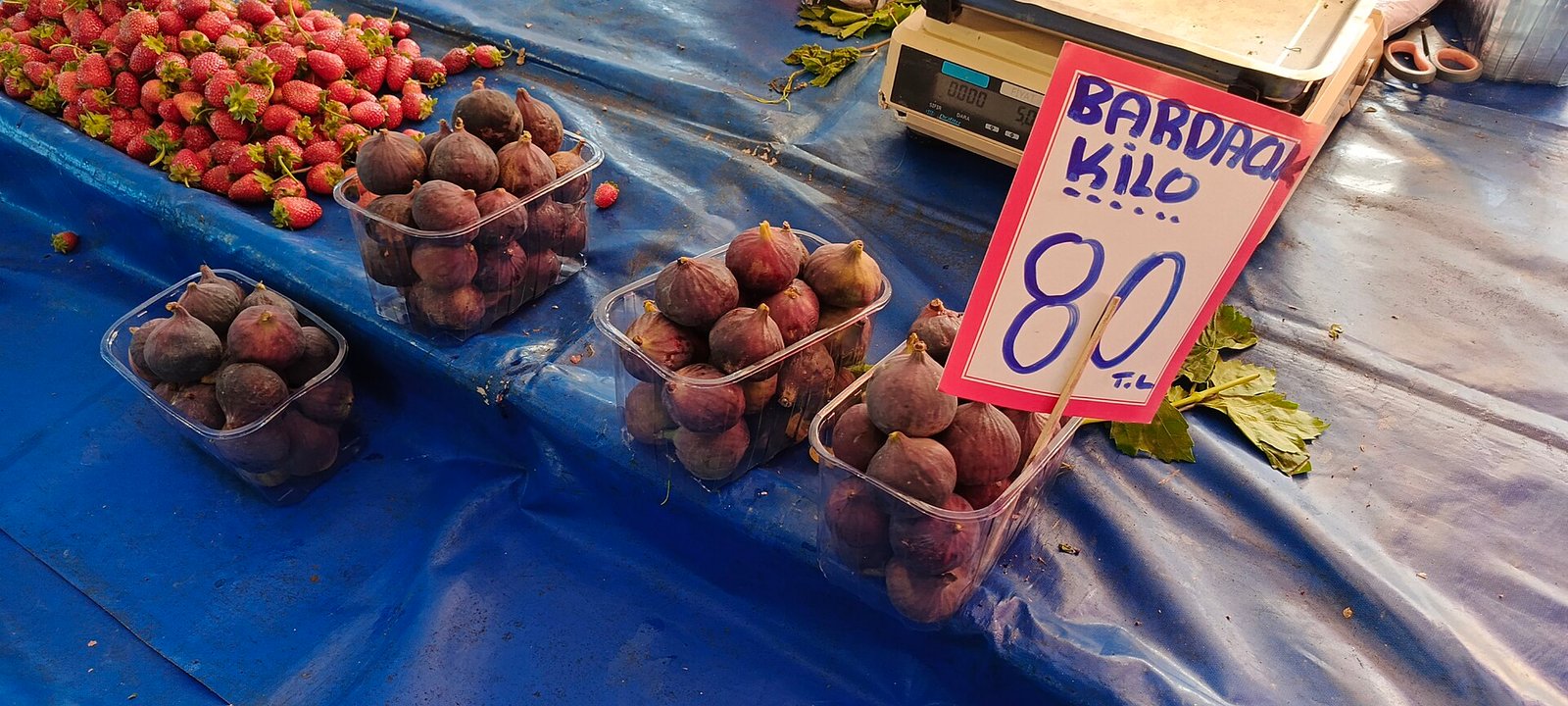
Bardacık figs are one of İzmir’s most distinctive late-summer fruits. The Ministry of Agriculture’s fig-variety catalogue describes Bardakçı — known around İzmir as Bardacık — as a fresh table fig with thin yellow-green skin, pink-red flesh and a ripening period from late July to early September.
That short season is the useful starting point for buying them. Bardacık is not the same product as the dried Sarılop figs associated with the wider Aegean export economy: it is a delicate fresh fruit best judged by the condition of the batch in front of you.
What is a Bardacık fig?
The official cultivar description lists Bardakçı as medium-sized and pear-shaped, with thin yellowish-green skin, visible veins and pink-to-red flesh. It is described as sweet, easy to peel and consumed fresh around İzmir, where the name Bardacık is commonly used.
Those characteristics are more useful than trying to identify the fruit from colour alone. Fresh figs can vary with maturity, handling and growing conditions, so a stall label and the seller’s information still matter.
When is Bardacık season in İzmir?
The Ministry catalogue gives a ripening window from late July to early September. Weather and location can shift the exact harvest from one year to another, so this should be read as a seasonal window rather than a guaranteed market calendar.
Late August is therefore a logical time to look for local Bardacık, but availability may already be uneven from seller to seller. If you are visiting İzmir specifically to try the fruit, do not assume it will remain common throughout September.
Where does the İzmir connection come from?
Bardacık is strongly associated with local fresh consumption rather than long-distance storage. Payamlı, a rural neighbourhood of Güzelbahçe, has built a recurring festival around the fruit. İzmir Metropolitan Municipality’s 20 August 2026 announcement for the 12th Payamlı Bardacık Festival also highlighted local Bardacık, grapes and almonds as products tied to the area’s agricultural identity.
The festival itself has now passed, but it is useful evidence of the fruit’s place in İzmir’s local food culture. Outside festival dates, neighbourhood markets, greengrocers and producers are more relevant places to look than a once-a-year event.
How to choose Bardacık figs
For fresh figs, buy for near-term eating rather than maximum quantity. Look for fruit that feels ripe without being collapsed, with skin that is intact enough to travel home. A little softness is normal in a ripe fig; leaking, extensive bruising or fermentation-like odour are reasons to choose another piece.
- Choose the quantity you realistically expect to eat soon.
- Keep heavier items out of the bag or container placed on top of the figs.
- If origin matters to you, ask the seller where the batch was grown rather than inferring it from the variety name.
- Compare more than one stall when possible; ripeness can differ considerably on the same day.
How should you carry and store them?
Thin skin is part of Bardacık’s appeal, but it also means the fruit bruises easily. Carry it in a shallow container if possible and avoid leaving it in a hot car or compressed under other shopping.
At home, refrigerate ripe figs if you are not eating them immediately and wash them shortly before eating rather than before storage. The practical rule is simple: Bardacık is a fresh seasonal fruit, not a pantry product.
Bardacık versus dried Aegean figs
İzmir and neighbouring Aydın sit within Türkiye’s major fig-growing region, but not every fig serves the same market. Sarılop is the best-known drying variety in the Aegean. Bardacık is useful to seek out for the opposite reason: it represents the local fresh-fruit side of the region’s fig culture.
If you are building a food itinerary around İzmir, that distinction makes Bardacık worth trying in season. Buy a small amount, eat it fresh and treat the short availability window as part of the experience rather than a problem to solve.