


Finding a company that claims to manufacture in Türkiye is easy. Search engines, fair directories and LinkedIn can produce dozens of names in a few days. The difficult part is establishing who genuinely controls production, can manage an export order and will reproduce the sample quality six months later.
İzmir and its surrounding industrial areas have meaningful capacity in machinery, metals, plastics, packaging, food, agricultural technology, textiles, renewable-energy equipment and other manufacturing fields. But an “İzmir manufacturer” label is not evidence of capacity or reliability. A disciplined qualification process narrows the list quickly and exposes expensive problems before the pilot order.
Prepare a buyer file before contacting suppliers
Asking only “Can you make this and what is the price?” creates quotations that cannot be compared. Send each candidate the same information package:
- Technical drawing, material and tolerances
- Estimated annual volume and proposed pilot order
- Target market and required compliance/certification
- Packaging, labelling and traceability conditions
- Expected lead time and Incoterms
- Acceptance criteria and test method
If a supplier receives clear information but responds only with an unusually low price, asks no technical questions and states no delivery assumptions, that is not speed. It is uncertainty deferred to a later stage.
Manufacturer or intermediary? Ask for five forms of evidence
- Registered legal name and production address
- Machine list and location of critical processes
- A recent reference for a comparable product or industry
- Scope of quality certificates and issuing body
- Responsibility for raw material, subcontracted processes and final inspection
Working with an intermediary is not automatically a problem. A capable sourcing company may coordinate multiple suppliers, quality and logistics. The risk is an intermediary hiding its role while accepting no technical responsibility.
A 100-point supplier scorecard
| Area | Weight | What to examine |
|---|---|---|
| Technical capacity | 20 | Machines, processes, engineering and tolerances |
| Quality system | 20 | Incoming, in-process and final controls; records |
| Compliance/documentation | 15 | Certificate scope, technical file and traceability |
| Delivery reliability | 15 | Capacity plan, sub-supplier dependence and history |
| Financial/corporate stability | 10 | Company age, ownership and basic financial signals |
| Communication/project management | 10 | Quality of questions, response time and accountability |
| Commercial terms | 10 | Price transparency, payment, tooling and IP |
If the cheapest quotation scores poorly, investigate the difference. A low price may reflect efficiency—but it may also omit the specified material, rely on uncontrolled subcontracting, reduce inspection or promise capacity that does not exist.
During the factory visit, follow the flow—not the presentation
Move from incoming material to shipment rather than spending the visit in the meeting room. Is there a quarantine area? How is non-conforming material identified? Are measuring-device calibration records current? Which drawing revision is at the workstation? Could materials for two similar parts be mixed?
Select one completed order and ask the team to trace it backwards. If raw-material lot, process record, inspection result and shipment document connect, the quality system is more likely to be operational rather than decorative.
Use three stages of samples
An engineering sample tests feasibility. An approval sample freezes the technical and visual standard. A pilot production run validates quality, lead time and packaging under serial conditions. One hand-finished perfect sample is not proof of production performance.
The pilot order should state acceptance criteria, measured characteristics, treatment of non-conforming goods, replacement time and responsibility for transport damage.
Contract clauses that should not disappear
- Technical appendices and revision control
- Ownership of tooling, drawings, brand and customer data
- No unapproved change of subcontractor
- Advance notice of raw-material or process changes
- Responsibility for defects, delay, rework and returns
- Audit and record-access rights
- Payment milestones and evidence of delivery
- Return of tooling and documents at termination
High-risk warning signs
Pause the process when several signals appear together: refusal to provide the factory address, photographs instead of a live production walkthrough, payment to an unrelated company account, certificates covering a different product scope, unexplained sample charges, “no problem” as the answer to every technical question, or pressure for 100% prepayment on the first order.
Expert analysis
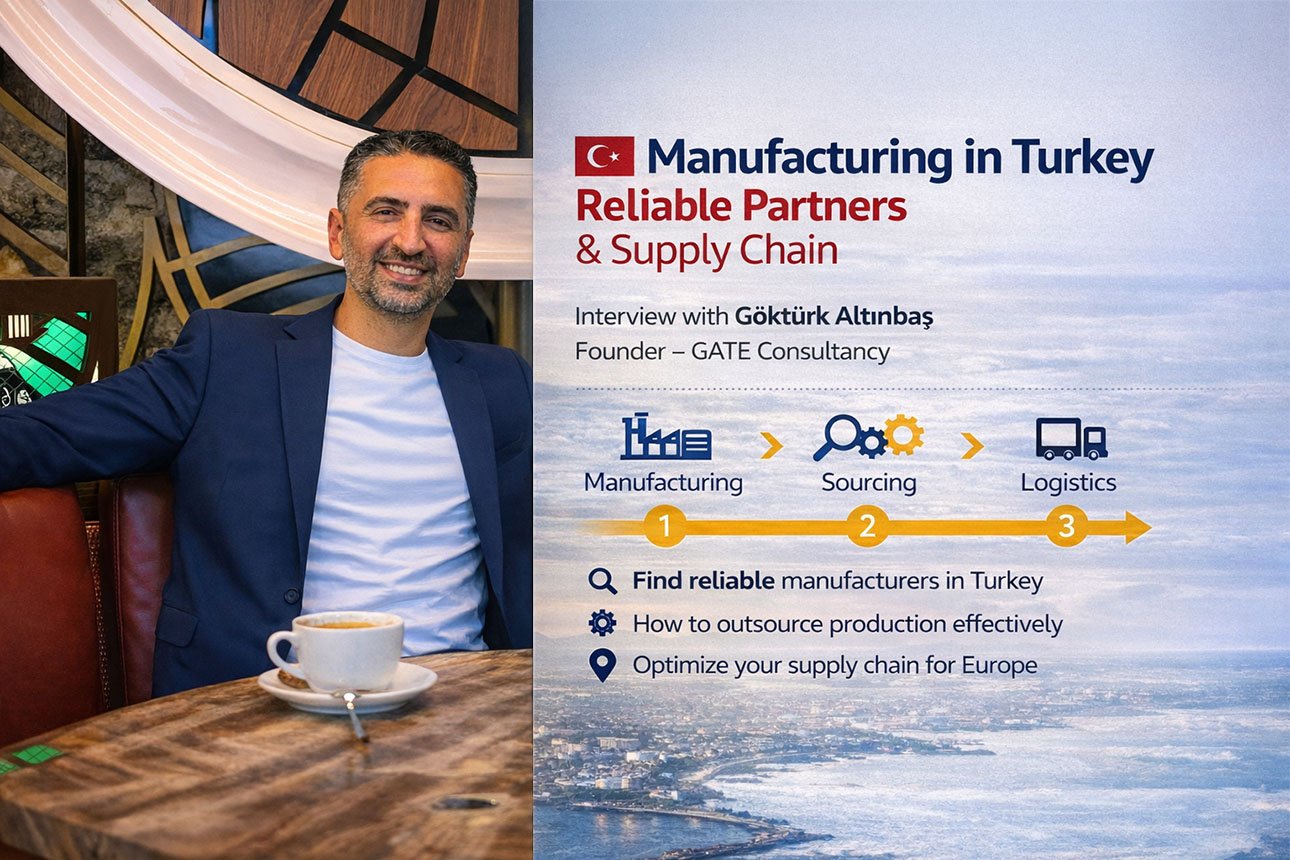
This field guide was written independently for OnlineIzmir. For a broader interview and analysis on building a Turkish supply chain and selecting reliable partners, read Mauro Benigno’s Manufacturing in Turkey: How to Find Reliable Partners.
Do not approve a supplier from online information alone. Depending on product and sector risk, use professional checks for registration, tax, certificates, sanctions, references, financial stability and on-site capability.
OnlineIzmir view: The best supplier is not the one that always says yes or quotes lowest. It is the company that identifies problems early, records evidence and reduces surprises in serial production. Verification before the first order is far less expensive than recovery after a quality failure.