


How to plan a heat-safer day in İzmir starts with the clock, not with a search for one magically cool route. July’s long, bright days can make a continuous programme of walking, errands, seaside time and bus travel look manageable on paper. The strongest low-cost change supported by national health guidance is simpler: place outdoor commitments before 10:00 or after 16:00, then make the middle of the day a genuine indoor pause rather than a chain of supposedly short exposures.
That routine fits İzmir’s summer baseline without pretending that climate averages predict a particular day. The Meteorology General Directorate’s 1938–2025 İzmir climate statistics give July a mean temperature of 28.0°C and a mean high of 33.3°C. July averages 12.4 hours of sunshine and only 0.45 rainy days, while August has a 33.0°C average high. Those figures explain why timing matters, but the historical July extreme of 43.2°C is a past record, not a forecast for a coming summer.
How to plan: compare the two daily routines
The useful comparison is between a continuous outdoor day and a split day. A continuous schedule can maximise errands, meetings or sightseeing in daylight, but it also concentrates walking, waiting and direct sun exposure during the period that the Health Ministry identifies for avoiding unnecessary outdoor activity: 10:00 to 16:00. A split day moves walk-heavy commitments into the morning and evening, with an indoor recovery period between them.
Check the MGM İzmir hourly forecast before setting either schedule. It provides temperature, feels-like temperature, humidity and wind information, and MGM says it is updated daily by 14:00 Türkiye time. A headline temperature is not enough for a walking or transit decision: humidity and wind can materially change conditions during an exposed wait, a waterfront walk or an outdoor errand. Climate normals provide context; the hourly forecast is the operational tool for the day ahead.
Option one: keep a continuous outdoor day
A continuous day is the convenience-first option: leave late in the morning, cross town, walk between appointments, spend time by the sea, then return in the evening. Its advantage is fewer interruptions and no need to build several hours indoors into the programme. Its weakness is cumulative exposure. Each short walk, stop and queue can add to sustained time outside when official guidance advises reducing it.
The seaside is not a noon exemption. The Health Ministry’s extreme-heat guidance treats sun exposure and sea bathing during the hottest hours as risks, so a waterfront plan still needs timing and shade rather than optimism. Nor should a green-looking or coastal route be presented as reliably cool. İzmir research finds that green-blue infrastructure can regulate local land-surface temperature, but the reach of cooling is linked more strongly to cool-island size than intensity. It does not provide a district-by-district comfort ranking.
Option two: build a split day around an indoor pause
The split-day alternative gives the morning a clear job: complete the walk-heavy errand, outdoor work, exercise or visitor itinerary early, then stop indoors through the middle of the day. Resume after the official avoidance window, using the hourly forecast to judge the later journey. This does not promise that every evening will be comfortable. It is a practical way to reduce unnecessary midday exertion without depending on a special route or a paid cooling service.
Build the pause around a place already needed for the day, such as home, accommodation, a workplace or another indoor commitment, rather than relying on an unverified cooling-centre network. Where possible, shade sun-facing windows. For time outside, the Ministry advises light, loose, light-coloured clothing and a ventilated wide-brimmed hat. It also recommends cooling the hands, feet, face and neck with cold water. These measures support a better schedule; they do not make a long midday outdoor programme equivalent to a split day.
What walking and transit can realistically do
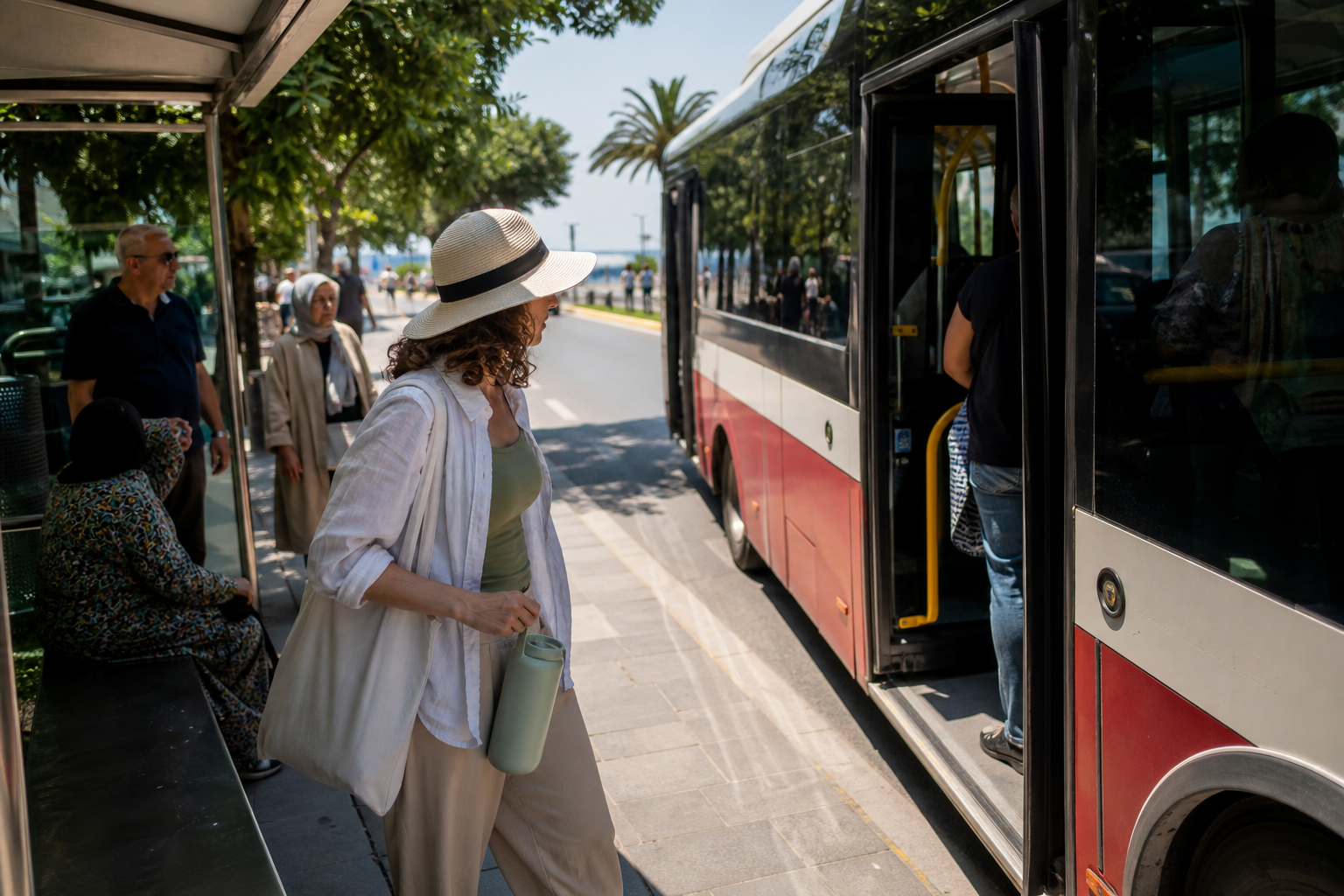
Walking offers flexibility and may cost nothing beyond time, but it increases direct sun exposure and makes detours more consequential. Public transport can reduce the time spent moving through outdoor heat, yet its weakest points may be outside the vehicle. An unshaded stop, a delayed connection or a transfer can undermine the apparent benefit. A midday transit decision should therefore include the whole journey: the walk to the stop, waiting time, changes and the walk from the final stop.
ESHOT said on 23 July 2026 that it operated more than 1,700 buses on 471 routes and was conducting pre-service air-conditioning tests, filter replacement and fault monitoring. That reported summer air-conditioning maintenance activity is useful mitigation, not a guarantee of a cool cabin on every journey. If a noon trip is necessary, transit may limit walking where feasible, but keep transfers modest and arrange an indoor destination. A bus should not be treated as the day’s cooling plan.
Which routine fits each situation?
For a resident with flexible errands, the split day is generally the stronger option: complete groceries or appointments early, stay indoors at midday, then make a shorter evening trip. Visitors can separate a morning outdoor sight from a later indoor break or evening meal rather than force an all-day waterfront itinerary. For an entrepreneur or company organising field activity, the practical decision is to shift outdoor work where possible, not simply to add a reminder about fluids.
Extra caution is warranted for groups the Health Ministry identifies as more affected by extreme heat: older adults, young children, pregnant people, outdoor workers, people with chronic illness and people who use certain regular medicines. Its general guidance advises 2–2.5 litres of fluid daily even without thirst, with water preferred. Alcohol, high-sugar drinks and caffeinated drinks are discouraged as substitutes. These are public recommendations, not personalised instructions for people with fluid restrictions or individual health concerns.
Use a decision framework before leaving home
Exercise needs a stricter timetable than an ordinary short trip. The Ministry recommends morning or evening exercise and advises two to four glasses of fluid per hour of exercise. Because exercise adds exertion, it belongs outside the 10:00–16:00 window rather than being fitted into a shaded route at midday. Before departure, decide where the indoor break will be, take water and choose the advised loose, light-coloured clothing and ventilated wide-brimmed hat.
A practical sequence is short: check MGM’s hourly conditions; move non-essential outdoor time outside 10:00–16:00; choose the least exposed practical journey; and retain an indoor fallback if conditions feel worse than expected. The need for a measured fallback is not abstract. A single-hospital study of a nine-day İzmir heatwave in June 2016 found mean daily emergency visits of 320, compared with 269 a year earlier, while in-hospital mortality was 1.6% rather than 0.7%. It is historical, single-hospital evidence, not a forecast of current demand.
If someone’s condition seriously deteriorates, do not try to manage the situation through route changes, cold water or further travel. Call 112, Türkiye’s integrated emergency system. It connects callers to the required service, and foreign-language calls can receive interpreter support. A split-day routine cannot promise immunity from heat, but it can make the most controllable decision early: avoid turning the hottest hours into a long sequence of exposure, transfers and exertion.
Sources
- mgm.gov.tr
- Aşırı Sıcaklardan Korunma
- İzmir için anlık hava durumu, saatlik ve 5 günlük hava tahmini | Meteoroloji Genel Müdürlüğü
- Haberler | ESHOT’tan yaz sıcaklarına karşı kesintisiz klima mesaisi
- rcastoragev2.blob.core.windows.net
- Kentsel Mekânda Soğutma Yayılımının Araştırılması, İzmir Örneği – Coğrafi Bilimler Dergisi
- ACİL SAĞLIK HİZMETLERİ GENEL MÜDÜRLÜĞÜ