


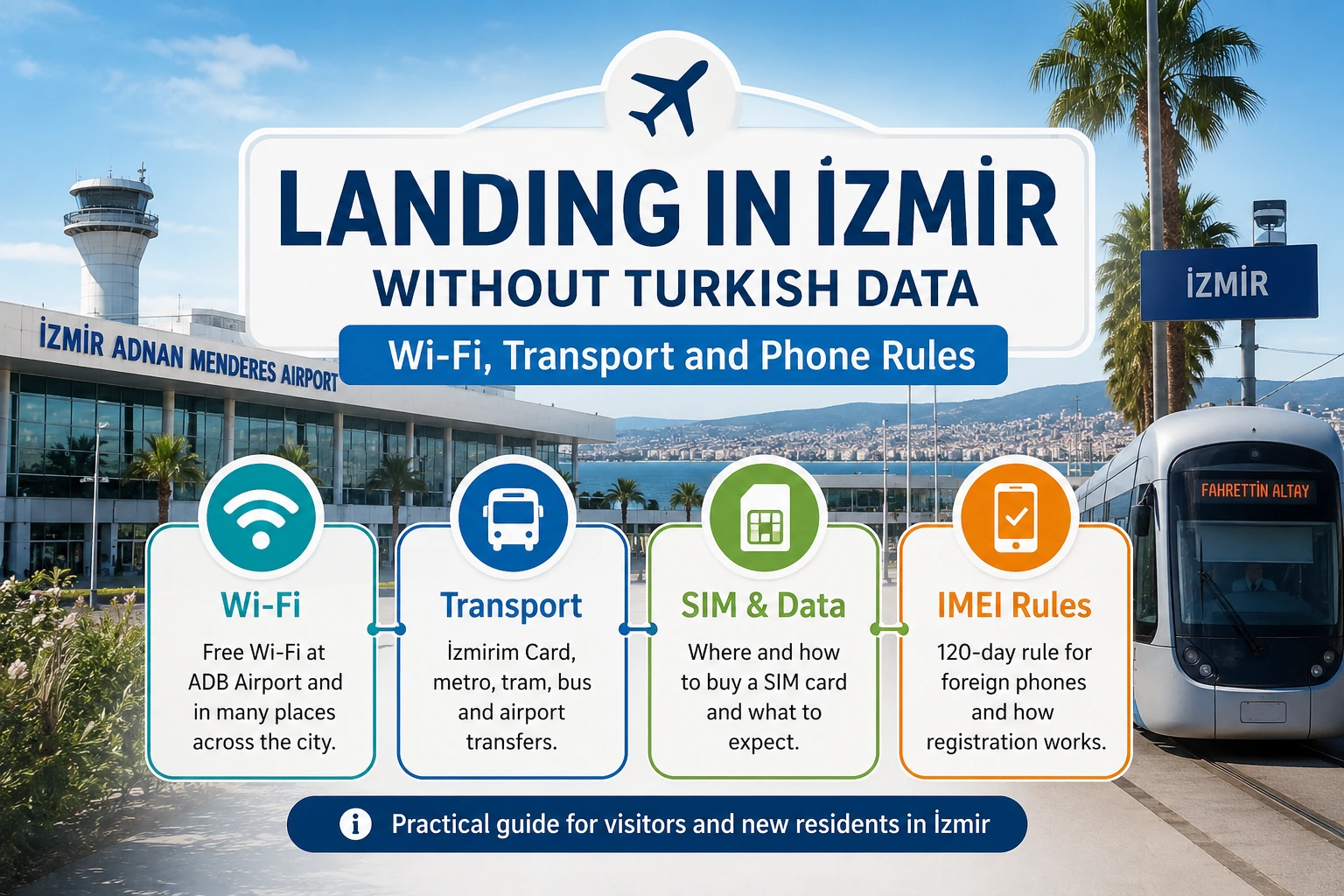
Landing in İzmir without a working Turkish mobile line does not require an immediate SIM purchase at the airport. Adnan Menderes Airport offers a way to get online, while İzmir’s transport system offers separate ways to pay for the journey onward. The useful first decision is not which operator to choose, but whether a local number is actually needed before leaving the terminal. For many arrivals, Wi-Fi, a transport product or a contactless card can cover the first stage.
Keep three issues apart from the start: connection, transport payment and the status of a phone brought from abroad. Airport Wi-Fi can provide an initial connection; an İzmirim product can pay for local transport; a passport may support an application for a prepaid line; and an imported handset has its own registration timetable. They involve different organisations and different decisions, so they should not be treated as one airport purchase.
Landing in İzmir: decide whether Wi-Fi is enough first
TAV Free Wi-Fi is available throughout Adnan Menderes Airport’s domestic and international terminals. The free allowance is one hour. Standard sign-in uses a mobile number and an SMS code, which may suit travellers whose existing number can receive messages abroad. It is less practical for someone without roaming access or without the ability to receive an SMS on that line.
TAV provides another route for passengers without roaming: a Wi-Fi password can be obtained from airport kiosks by presenting identification. An independent airport-services guide also records the one-hour TAV-FREE-WIFI service and its SMS-based login, but TAV’s instructions are the relevant authority at the terminal. The practical consequence is simple: a Turkish number is not required just to get online and organise the journey from the airport.
Which institution is responsible for each task?
TAV handles airport connectivity, rather than mobile-line sales or foreign-handset registration. İzmir’s transport system handles the local card products, sales points and published fares. Mobile operators set conditions for opening their own lines, including store-level requirements. A passenger can therefore use airport Wi-Fi, obtain a transport product and defer the decision on a local line without preventing an onward public-transport journey.
BTK, Türkiye’s communications authority, separately administers guidance on devices brought from abroad and rules on subscriber records. That division matters in everyday terms. An operator’s decision to sell a prepaid line does not settle whether an imported phone needs registration later. Equally, the imported-device timetable has no bearing on whether Wi-Fi, a card product or a contactless bank card can be used immediately after arrival.
How can you pay for the first public-transport trip?
The İZBAN airport station has several documented places to obtain an İzmirim product. Municipal guidance says that İzmirim Kart and Bilet35 are available from the airport-station counter during office hours, an International Arrivals special booth, and station machines until the last service. The published 2026 tariff gives a price of TL200 for an anonymous İzmirim Kart and TL35 for Bilet35.
Bilet35 is a disposable multi-ride product offered in three-, five- and ten-trip versions. It is an alternative to buying an anonymous card when that format fits the traveller’s planned use. For airport buses 200, 202, 204 and 206, the published comparison is clear: the fare is TL77 with an İzmirim Kart and TL86 with a contactless bank or credit card. Contactless payment can therefore get a passenger moving without a local transport product, but it costs TL9 more on these routes and brings no 90-minute transfer entitlement.
Should the onward journey be by rail, airport bus or Havaş?
A flat airport-bus fare is not automatically cheaper than rail. Airport buses use a special flat fare, whereas the published İZBAN tariff is distance-priced: it begins at TL40 for the first 20 kilometres, followed by a per-kilometre charge. İZBAN also has no 90-minute transfer entitlement. The rail total therefore depends on the distance travelled rather than a single airport supplement.
Start with the destination, not with a general assumption about the cheapest airport option. The four listed airport-bus routes have the stated airport fare, while rail is calculated by distance. Havaş publishes shuttle services boarding at the Domestic/International Arrivals-floor exit for the city centre, Kuşadası, Aydın and Çeşme corridors, with fares varying by destination. Airport buses also do not receive the Halk Taşıt time-window discount, so a general city-fare expectation does not apply to this airport leg.
What does buying a local line change—and what does it not change?
If a local number is needed after arrival, take a passport and ask the chosen operator what applies to that specific line. Vodafone says tourist prepaid SIMs are available using a foreign passport number, advises customers to bring a passport and local address, and notes that new-SIM fees can vary by shop. Turkcell also lists a valid passport among accepted documents for a prepaid line. These are operator eligibility signals, not one universal documentation rule for every store or product.
Line purchase and use of a foreign handset are separate matters. BTK states that an unregistered phone brought from abroad may be used for 120 days from entry before communications service is closed. Its foreign-device registration guidance directs eligible users to e-Devlet for registration. A new local SIM can meet an operator’s line-purchase conditions, but it does not remove the 120-day clock attached to the imported device.
What should a short visitor and a longer-stay resident do differently?
For a seven-day visit, it can be reasonable to use airport Wi-Fi, choose rail, airport bus or Havaş by destination, and decide later whether a tourist line is useful. That sequence avoids treating an airport SIM as essential simply because the traveller arrived without Turkish data. It also avoids making a hurried decision when operator fees may vary by shop and no dependable airport-versus-city SIM price comparison is available.
A person moving for work, study or a longer stay can use the same first-day arrangement, then make two separate follow-up checks: confirm the operator’s conditions for a local line and consider whether the handset brought into Türkiye needs registration planning before the 120 days expire. The 2026 BTK subscriber-record measure should also be read narrowly. It concerns specified existing foreign-subscriber records, gives affected subscribers six months from 25 June 2026 to update records, applies staged restrictions from 25 July and then from 5 September through 24 October 2026, and provides for immediate lifting after an update. It is not a basis for claiming that every new tourist SIM will be affected.
Which arrival mistakes are easiest to avoid?
The first failure point is relying on SMS login when the existing number cannot receive the code. In that situation, use the identification-based airport kiosk route rather than assuming a Turkish SIM is the only answer. The second is expecting a standard transfer arrangement on an airport trip. Neither the listed airport-bus fares nor İZBAN has the 90-minute transfer entitlement, and airport buses do not receive the Halk Taşıt discount.
The final mistake is merging every phone-related rule into one warning. Passport-based eligibility to buy a line, the 120-day rule for an imported handset, and the 2026 record-verification measure concern different things. On arrival, solve the immediate connection and transport questions first. If a local line or long-term use of an imported phone is needed, address those as separate decisions using the operator’s current conditions and BTK’s relevant guidance.
Sources
- izmirairport.com
- btk.gov.tr
- izmirimkart.com.tr
- İzmir Adnan Menderes Airport
- Izmir ADB Airport Services – What to Expect
- İzmir Büyükşehir Belediyesi
- İzmir Büyükşehir Belediyesi
- Tourist Prepaid SIM Card in Turkey | Vodafone
- Yabancı Uyruklular için Turkcell Kampanyalı Hatlar
- Merkezi Cihaz Kayıt Sistemi – BTK Tüketici Sitesi
- Doğrulama yapmayan turistlerin hattı kapanacak – Turizm Ekonomi – Turizm Haberleri – Turizm Gazetesi