


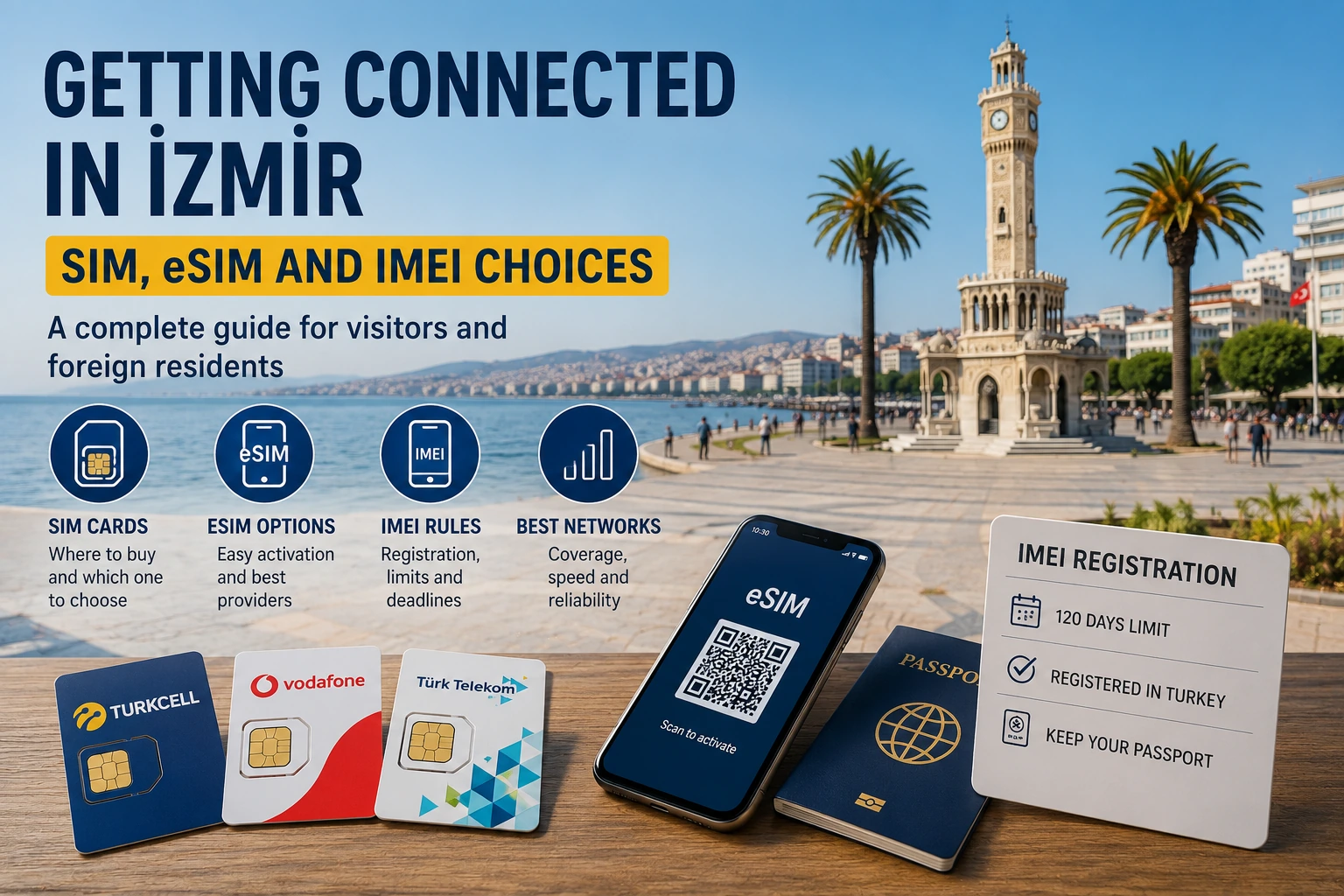
Getting connected in İzmir is not simply a matter of choosing the largest data allowance at a shop counter. The practical choice turns on three separate questions: how long you will stay, whether your phone was bought outside Türkiye, and whether you need a locally issued Turkish line or only mobile data. A seven-day visitor and a new resident may consider similar-looking packages, yet face very different rules when a foreign handset approaches its 120-day limit.
The crucial distinction is easy to miss after arrival. A passport can support registration for a tourist prepaid line, while IMEI registration concerns the handset itself and is administered through BTK and e-Devlet procedures. Buying a Turkish SIM, including a Turkish operator eSIM, does not register an imported phone. For a short visit, that separation may have little immediate effect. For a longer stay, it can determine whether the phone remains able to use communication services.
Getting connected in İzmir: comparison criteria
Start by separating the three routes. An international travel eSIM is a data product from a travel-eSIM provider and can be installed before departure. A Turkish tourist SIM or eSIM is a locally issued subscriber line, sold by an operator under its registration rules. IMEI registration is neither a package nor a line purchase: it is the process used by eligible holders of imported handsets that need to continue using Turkish communication services beyond the permitted period.
That separation changes the comparison. Package price matters for a short trip, but it does not answer whether a foreign-bought phone will remain usable months later. BTK states that an imported device not registered within 120 days is closed to communication services. The 120-day period attaches to the handset’s first use, rather than to the expiry date of a tourist package. Buying another short-term bundle therefore does not reset the device deadline.
First option: install a travel eSIM before arrival
A travel eSIM can suit a visitor who mainly wants mobile data immediately after landing and prefers not to make an operator shop the first task of the trip. Installing the profile before departure is a practical precaution: it can provide a connection before the traveller chooses between airport and city purchase routes, or decides whether a Turkish number is needed later.
The precaution is particularly relevant because independent reporting says access to at least 35 eSIM-provider services has been blocked in Türkiye. Downloading and activating a travel eSIM before entry can reduce the risk of being unable to reach a provider’s app or website after arrival. That reporting does not show that every travel eSIM stops working in Türkiye. It shows why pre-installation is sensible when post-arrival access to a provider’s support or account tools may be limited.
Second option: buy a Turkish tourist line
A Turkish operator line is the direct route for a visitor who wants a locally issued subscriber number. Vodafone says its tourist prepaid offer is for subscribers registering with a foreign passport and is available as either a physical SIM or eSIM in Vodafone shops. Its eSIM is therefore a Turkish operator line, not the same product as an international travel eSIM, even though both can appear on a handset as eSIM profiles.
Türk Telekom says tourist prepaid SIMs are sold through airport dealers or nearby stores, with package selection made at activation or later by SMS. Its tourist-package conditions include having declared a passport or identity document within the previous 90 days. Customers may buy only one listed Welcome package, and the packages do not renew automatically. These are finite, passport-linked tourist offers rather than an open-ended answer to the imported-device question.
How do cost, time and usage differ?
Published offers show why duration matters alongside the headline data allowance. Türk Telekom lists a tourist offer with 10 GB, 250 minutes and 250 SMS for 320 TL over seven days, as well as advertised 25 GB and 50 GB packages for 28 days. Turkcell lists a 1,350 TL campaign price for a 28-day Tourist Pack, with stated campaign validity through 31 December 2026. Prices and campaign terms can change, so these figures are comparison points rather than a promise of a particular counter price.
The airport is best treated as a fast first-connection route, not as a proven best-value route. Türk Telekom identifies airport dealers as a tourist-SIM channel, which supports buying a line immediately after landing when a connection is the priority. It does not establish that airport prices are lower, higher or uniform. Waiting until town may give a buyer time to choose between a physical SIM and eSIM or to visit an authorised outlet, but it is not evidence of a better deal.
Which route fits a short stay or a long one?
For a visit of around a week or a few weeks, the practical choice is usually between a pre-installed travel eSIM and a passport-registered Turkish tourist line. Pick the travel eSIM when immediate data and fewer arrival tasks matter most. Pick the local line when a Turkish operator number is more useful. Airport purchase favours speed; a city outlet lets the purchase wait. Vodafone’s İzmir directory lists authorised outlets including locations in Konak and Buca, but it does not establish live stock, outlet hours, fixed prices, foreign-card acceptance or English-language service.
For someone expecting to pass the 120-day mark with a foreign-bought phone, the imported handset becomes the priority. A tourist line can be adequate in the first weeks, yet it does not change the device limit. This is the practical trade-off many long-stay users miss: a 28-day package and a 120-day handset allowance run on separate clocks. A Turkish SIM or operator eSIM solves the subscriber-line choice, not the IMEI-registration requirement.
Decision framework: check the handset before committing
First establish whether the phone was bought outside Türkiye, then retrieve its IMEI by dialling *#06#. Its status can be checked through e-Devlet or BTK’s consumer contact route. BTK says a traveller may bring one device every three years. It also says that a registered device works only with GSM lines held in the same passport holder’s identity, so putting a line in another person’s name does not remove that identity link.
Eligible foreign nationals with a Foreign Identity Number and an e-Devlet password can register a device online. BTK identifies e-Devlet as the single registration channel for Turkish and foreign identity-number holders. A foreign-bought device can be used without IMEI registration for up to 120 days from first use, while registration must be completed within 365 days of entry to continue service. Paying the IMEI charge alone does not complete registration: the e-Devlet process must be finished and an eight-digit application tracking number obtained. For a long stay, assess that route before comparing data allowances or deciding where to buy the first line.
Sources
- turkiye.gov.tr
- bne IntelliNews – Turkey blocks e-SIM providers
- Merkezi Cihaz Kayıt Sistemi – BTK Tüketici Sitesi
- Information Regarding Notifications Made Within the Scope of the e-Government IMEI Registration Service | Bilgi Teknolojileri ve İletişim Kurumu
- Prepaid Tourist SIM Turkey | Türk Telekom
- Mobil Faturalı & Faturasız En İyi Tarife Fiyatları | Türk Telekom
- Tourist Prepaid SIM Card in Turkey | Vodafone
- İzmir Vodafone Mağazaları İletişim Bilgileri | Vodafone
- Avantaj Turist Tanışma Seti
- www.aa.com.tr
- Best eSIM for Turkey in 2026