


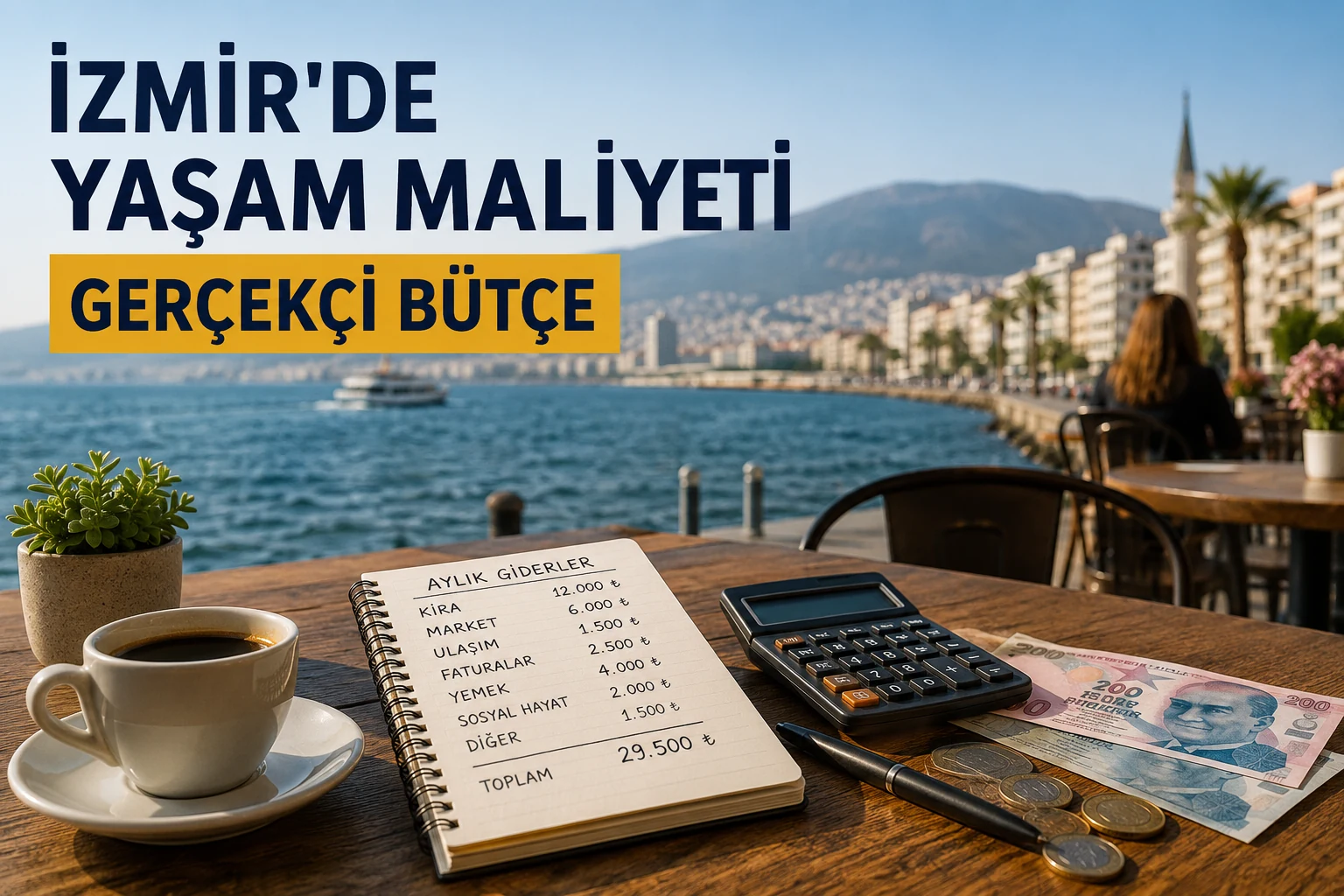
How much money do you really need to live in İzmir? It is easy to answer with a confident round number—“₺50,000 is enough” or “you need at least ₺100,000.” The honest answer is more useful: İzmir does not have one cost of living. It has several, shaped by where you rent, whether you need a car, how often you eat out, whether you have children and how much financial friction comes with being new to Türkiye.
This guide replaces vague advice with July 2026 benchmarks, current listing examples and worked monthly budgets. The figures are not a promise: rents can change within days, and crowdsourced price databases are not official statistics. Used carefully, however, they show something a generic average cannot—how much cash you need to move in, what a normal month may cost and whether your income leaves room for savings.
The numbers that matter right now
| Expense | July 2026 benchmark | What it means in practice |
|---|---|---|
| One-bedroom rent, central area | Average ₺29,000; common range ₺25,000–35,000 | Alsancak, central Konak, the Karşıyaka waterfront and newer buildings pull the figure upward. |
| One-bedroom rent, outside the centre | Average ₺20,500; common range ₺17,000–25,000 | Buca, Menemen and outer parts of Bornova can be cheaper, but distance from rail or ferry links matters. |
| Three-bedroom rent, central area | Average ₺55,571; range ₺45,000–75,000 | New construction, parking, security and a sea view create large premiums. |
| Three-bedroom rent, outside the centre | Average ₺38,333; range ₺30,000–50,000 | For families, school and commuting costs can outweigh the rent saving. |
| Basic utilities for an 85 m² home | Average ₺4,200; seasonal range ₺2,000–8,000 | Air conditioning, electric heating, insulation and working from home can double the bill. |
| Home internet | About ₺776; range ₺600–1,000 | Check installation, commitment period and the actual infrastructure available at the address. |
| Mobile plan | About ₺522; range ₺250–800 | Newcomer packages and high-data plans may sit near the top of the range. |
| Public transport | ₺35 for a full-fare central-network boarding | With İzmirim Kart, eligible transfers during the next 90 minutes are included after the first boarding. |
| Inexpensive restaurant meal | Average ₺450; range ₺300–950 | A workers’ lunch and a waterfront restaurant should not be treated as the same category. |
| Cappuccino | Average ₺178; range ₺110–220 | One café coffee every day approaches ₺5,300 per month. |
| Gym membership | Average ₺3,165; range ₺1,500–4,000 | Annual payment may be cheaper, but a long contract is risky during your first months. |
Why the first month can cost twice as much as a normal month
Monthly budgets hide the amount of cash required on signing day. Imagine renting a one-bedroom apartment at the current central average of ₺29,000 through an estate agent:
| Move-in item | Worked example | Comment |
|---|---|---|
| First month’s rent | ₺29,000 | Usually paid when the contract begins. |
| One-month security deposit | ₺29,000 | One or two months is common in practice; Turkish law caps the security at three months’ rent. |
| Estate-agency service fee | ₺34,800 | One month’s rent plus 20% VAT in this example. The regulatory ceiling is one month’s rent excluding VAT. |
| Utility setup, moving and basic household items | ₺15,000–30,000 | Highly dependent on whether the apartment is furnished and which subscriptions already exist. |
| Cash needed at the beginning | ₺107,800–122,800 | A two-month deposit would add another ₺29,000. |
Renting directly from the owner can remove the agency fee and reduce this example to roughly ₺73,000–88,000. Furniture, appliances, air-conditioning or additional documentation can push it back up. Treat move-in capital as a separate budget, not as part of an ordinary month.
Four realistic monthly budgets
These are not survival budgets. They are models designed to remain sustainable for at least three months, with a small reserve rather than spending every lira.
1. Shared and controlled
₺34,000–42,000 a month
- Rent share: ₺13,000–18,000
- Share of utilities, internet and mobile: ₺2,500–3,500
- Groceries and home cooking: ₺8,000–10,000
- Public transport: ₺1,500–2,200
- Social and personal spending: ₺4,000–5,000
- Emergency margin: around ₺3,000
This model assumes two or three adults sharing a larger apartment outside the central premium zones. The main risk is saving on rent but losing money and time through an exhausting commute.
2. Solo professional outside the centre
₺50,000–62,000 a month
- Rent: around ₺20,500
- Utilities, internet and mobile: ₺5,000–6,000
- Groceries: ₺9,000–12,000
- Public transport: ₺1,500–2,300
- Eating out and coffee: ₺4,000–6,000
- Sport, health, personal spending and reserve: ₺8,000–12,000
The midpoint worked example is ₺52,983. This is a credible starting model for one person without a car who cooks most meals at home.
3. Central, social and comfortable solo life
₺68,000–85,000 a month
- Rent: ₺29,000–35,000
- Utilities and communications: around ₺6,000
- Groceries: ₺11,000–13,000
- Transport and taxis: ₺2,500–4,000
- Restaurants, coffee and social life: ₺7,000–10,000
- Gym, culture, personal care and reserve: ₺10,000–15,000
The midpoint model reaches ₺70,963. A seaside location is not the only reason: café, restaurant, taxi and convenience spending often cluster around a central lifestyle.
4. Family of four
₺150,000–190,000 a month
- Three-bedroom rent outside the centre: ₺38,000–50,000
- Utilities and communications: ₺8,000–11,000
- Groceries and household needs: ₺35,000–45,000
- Transport: ₺6,000–12,000
- Health, clothing, children and leisure: ₺30,000–45,000
- Reserve and monthly share of annual costs: ₺15,000–25,000
This excludes private school. Crowdsourced benchmarks place private full-day preschool at about ₺36,214 a month and international primary school at roughly ₺725,758 per child per year. Education can therefore change the entire family budget.
Transport: a ₺35 fare or a car?
Forty-four full-fare boardings—one outward and one return journey over 22 working days—cost ₺1,540. Add weekends and extra trips and a realistic public-transport budget may be ₺1,800–2,300. On routes covered by the 90-minute transfer rule, a metro-to-bus or ferry-to-tram journey does not necessarily mean paying two full fares.
A car calculation must go beyond fuel. Driving 800 kilometres a month in a car consuming 7 litres per 100 kilometres uses 56 litres. At the July 2026 benchmark of about ₺62.49 per litre, fuel alone is approximately ₺3,499. Parking, insurance, servicing, tyres, tax and depreciation can push the monthly operating cost to ₺8,000–15,000 before any loan or purchase cost.
The gap between the average central one-bedroom rent (₺29,000) and the outside-centre average (₺20,500) is ₺8,500. If the cheaper apartment makes a car necessary, most or all of the rent saving may disappear. Compare rent + transport + time lost, not rent alone.
How eating out quietly adds ₺7,500 before groceries
Eight inexpensive restaurant meals at ₺450, twelve coffees at ₺178 and your half of two mid-range dinners for two add up to roughly ₺7,532. That is before buying milk, vegetables, meat or household supplies. One café coffee every day approaches ₺5,300 a month on its own.
Keep groceries and eating out in separate categories. A single person cooking most meals and using weekly markets can model roughly ₺9,000–12,000 for groceries; imported food, alcohol, delivery and specialist diets can raise it quickly.
The salary reality check
Numbeo’s crowdsourced estimate for average monthly net salary in İzmir is about ₺53,805. The same source estimates one person’s monthly costs excluding rent at ₺34,285 and an outside-centre one-bedroom at ₺20,500. Together, that is ₺54,785.
This is not an official income study, but the comparison is revealing: one average salary is roughly equal to an average solo budget with little room left for saving. Shared housing, family-owned accommodation, employer benefits or foreign-currency income can change the equation; living alone at market rent remains the pressure point.
Foreign-currency income can create false confidence
Earning in euros or dollars may look comfortable against today’s lira costs, but rent, services and exchange rates do not move together. If a ₺70,000 lifestyle becomes 12% more expensive, you need another ₺8,400 every month to maintain it. Track the lira cost itself, not only the euro equivalent.
A practical reserve is at least three months of essential spending: ₺150,000 for a ₺50,000 core budget, or ₺210,000 for a ₺70,000 one. That buffer is what protects you from an urgent move, healthcare, flights or currency movement.
Build your own number in twenty minutes
rent + service charge + average utilities + communications + transport + groceries + eating out + health/personal care + monthly share of annual costs + at least 8–10% reserve.
- Choose three districts and save at least 15 current listings in each.
- Ignore the citywide average and take the median of the five homes you would genuinely rent.
- Test the commute twice at the times you would actually travel.
- Set separate limits for groceries, restaurants and coffee.
- Keep move-in costs outside the monthly budget.
- Increase the final figure by 10%. If the model breaks, the lifestyle is financially fragile.
İzmir is not simply cheap or expensive. It can be balanced with the right district, a car-free routine and controlled social spending; it can become unexpectedly costly through the wrong home, a large move-in bill and small expenses repeated every day. The useful number is not a city average. It is the amount that allows your chosen version of İzmir to continue without constant financial stress.
Data and verification links
- Numbeo — Cost of Living in İzmir, updated 13 July 2026
- İzmirim Kart — fares effective from 1 April 2026
- İzmirim Kart — 90-minute transfer rules
- Hepsiemlak — current one-bedroom rental listings in İzmir
- Ministry of Trade — ceiling on rental brokerage service fees
- Turkish Code of Obligations — security deposit, Article 342