


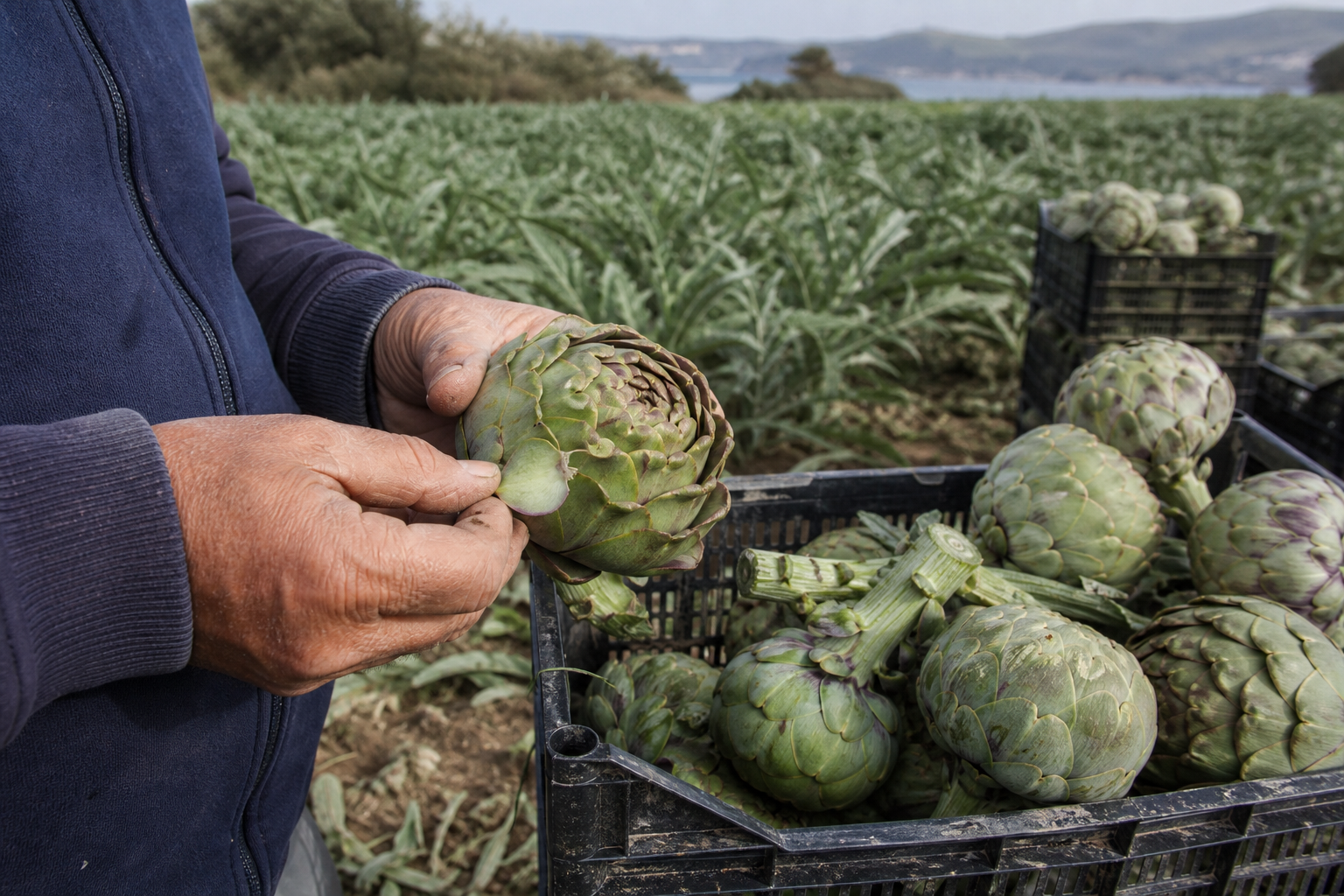
Urla Sakız Artichoke is not simply a menu description for an artichoke served in Urla. It is a protected regional product with an early harvest calendar, a defined geographical area and a culinary identity built around using more of the fresh head than only its heart. For buyers in İzmir, the useful distinction is not between a supposedly “good” and “bad” artichoke, but between documented provenance, cultivar, season and the format required for a planned dish.
That distinction matters because a large, attractive head or a premium price cannot, by itself, prove origin. Sakız and the later Bayrampaşa cultivar have recognisable differences, but research cautions that physical form alone cannot always separate Sakız from the related Yerli type. A more useful purchase begins with a seller who can explain where the crop was grown, who supplied it and whether it is fresh seasonal produce, stored produce or a processed product.
Origin, protection and the meaning of “Urla”
Urla Sakız Enginarı’s geographical-indication registration is a Turkish menşe adı, a protected designation whose rules require production, processing and the other defined operations to take place within its specified geography. This is more specific than a loose regional association: the registration defines both the protected product and the area to which the designation applies. It does not, however, make every informal use of “Urla” on a sign or menu self-validating.
The protected geography is wider than Urla district alone. It includes Urla, Çeşme, Karaburun, Balçova and the Mordoğan area, as recorded in the registration and in Urla district’s product information. In practical buying terms, “Urla” is a regional provenance claim, not necessarily a statement that each head was grown in Urla town. That broader boundary is part of the registered definition, so a product from another named area may still fit the designation’s geography.
Production and supply in İzmir’s peninsula districts
Sakız is an early artichoke: its stated harvest period runs from November through April. Production is not a simple annual sow-and-harvest cycle, because artichoke plants are perennial and are described as having an economic life of six to eight years. Crop timing consequently has operational importance. Mid-August “awakening” irrigation is identified as the crucial first irrigation that begins active growth, while winter conditions and other weather effects can influence earliness and available supply.
Scale should not be confused with uniformity. In April 2025, İzmir’s provincial agriculture directorate reported roughly 8,000 decares of artichoke land and 11,000 tonnes of annual provincial harvest, concentrated in peninsula districts, when announcing the start of the geographical-indication harvest. That provincial figure covers artichokes generally; it does not prove the origin or cultivar of an individual head at retail. The buyer’s decision still turns on traceability when a regional designation is being offered.
Urla Sakız Artichoke: provenance questions that work
The most useful question is direct: “Was this grown within the registered area, and can you identify the grower or supply chain?” A precise answer gives a buyer more to assess than the phrase “it is from Urla.” Follow-up questions can establish whether the head is Sakız, when it was harvested and whether it has been refrigerated, frozen, vacuum-packed or otherwise processed. None of those formats is inherently undesirable, but they are not interchangeable with a fresh seasonal harvest.
Appearance is useful as a screening tool, not a certificate. Sakız heads are described as more cylindrical, with flatter, less divided early leaves and a relatively narrower receptacle. Yet a genetic and morphological study found differences between Sakız and Bayrampaşa while also concluding that morphology may be insufficient to distinguish Sakız from the related Yerli type. A visual verdict should therefore yield to supply-chain information when provenance affects the purchase decision.
Sakız versus Bayrampaşa: technique and quality markers
Bayrampaşa is a distinct, later cultivar, generally larger, tighter and heavier than Sakız. It ripens in May and June and is used both fresh and for canning. Sakız’s earlier calendar and its suitability for using more of the fresh head create a different choice at the counter: a buyer planning a whole-head or stuffed preparation should not assume that the biggest head is the most suitable one.
The edible structure is the unopened flower bud. With fresh Sakız, both bracts and the receptacle can be used in whole-head and stuffed preparations, rather than treating the heart as the only worthwhile portion. Smaller heads are therefore not automatically inferior, because tender bracts are part of their culinary value. This creates a practical trade-off between a heart-centred preparation and one designed around the fresh head’s broader usable parts.
What food science can—and cannot—say about quality
Food-science research provides another reason not to equate size with value. A peer-reviewed study found that baby-artichoke hearts had higher measured phenolic content, while increasing maturity significantly reduced measured phenolic content and antioxidant activity. These findings describe composition under the study’s measurements. They do not establish that an artichoke can treat illness or support therapeutic marketing.
The same research identified leaves, stems and outer bracts as residues with potential bioactive components, and found generally higher measured total phenolic content in Sakız parts than in corresponding Bayrampaşa parts. For cooking, the grounded implication concerns use and waste: outer material need not automatically be regarded as discard. Composition findings neither establish the geographical authenticity of an individual head nor provide a basis for medical claims.
Where and how to experience the season without selection mistakes
For a fresh whole-head experience, the decisive window is November to April. A claim that a local Sakız head is fresh in high summer needs a clear explanation: it may be cold-stored, frozen, processed, or it may be a different cultivar. Documented production guidance also says harvested heads should avoid water contact and may be cold-stored under specified conditions. Ask about the product format before treating appearance as evidence of fresh seasonal status.
Price is market context, not proof. A local report dated 30 April 2026 quoted 30 Turkish lira at field level and a 50-lira market average during that harvest period, while stakeholders attributed a claimed 20% crop increase to winter rainfall in the reported 2026 harvest conditions. These are dated observations, not a current citywide price benchmark or an authenticity test. Outside the fresh season, frozen, vacuum-packed and other processed forms can extend access, but should be chosen for their format and convenience rather than mistaken for the same fresh-harvest proposition.
Sources
- ci.turkpatent.gov.tr
- Urla Kaymakamlığı – Urla Mahsülleri
- DETERMINATION OF OPTIMUM GA3 CONCENTRATIONS AND AWAKENING IRRIGATION TIME FOR GLOBE ARTICHOKE (CYNARA SCOLYMUS L. CV. SAKIZ) GROWN IN MEDITERRANEAN REGION OF TURKEY – ishs
- Assessment of genetic variation among local artichoke varieties by RAPDs and morphological characters
- Farklı Olgunluklarda Tüketilen Sakız Enginarının (Cynara Scolymus L.) Biyoaktif Bileşenlerinin İncelenmesİ – Journal of Advanced Research in Natural and Applied Sciences
- Coğrafi İşaretli Urla Sakız Enginarı Hasadı Başladı
- Urla’da sakız enginarının hasat mesaisi sürüyor İhlas Haber Ajansı