


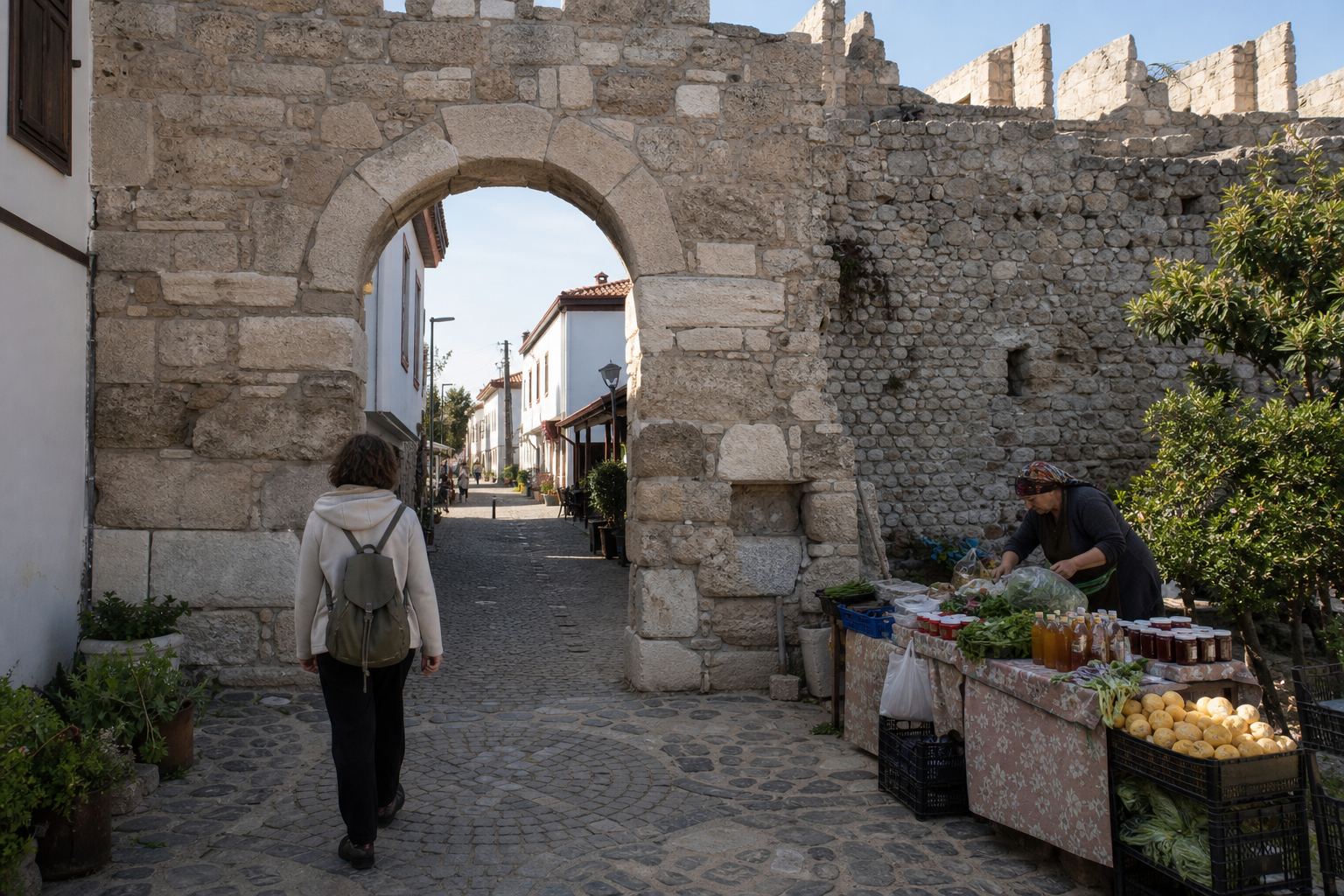
The Sığacık Castle and nearby Teos are best read as two connected places with very different terms of use. Within the castle walls, Kaleiçi is an inhabited quarter of homes, food businesses and shops. Teos, by contrast, is a separately ticketed archaeological site with seasonal gate hours and a visitor landscape shaped by conservation work. Their connection is real, even physical, but it does not make the corridor one frictionless old-town walk.
That distinction should shape a visit from the outset. Sunday brings a producer market into the castle quarter and changes the pressure on its streets, while Teos requires attention to admission, last-ticket times and the separate journey to the site. International visitors also need to know that the published foreign-visitor price is separate from the everyday, lived-in fabric of Kaleiçi. Treating Sığacık as only a marina stop misses the relationship between the fortified settlement and the ancient city whose stone appears in its walls.
Why The Sığacık Castle–Teos corridor matters now
The immediate contrast is between an everyday neighbourhood and a managed heritage site. Visit İzmir describes Kaleiçi as a district of houses, shops and food businesses, while the Ministry of Culture and Tourism lists Teos separately at Teos Caddesi No. 59, Sığacık. The official Teos site page also lists toilets, parking and a shop. Those facilities and the entry system make Teos a destination with its own operations, not simply an extension of the castle lanes.
For international readers, the published admission categories are a practical starting point. The Ministry’s current fee schedule lists Teos admission at €3 for foreign adults and foreign visitors aged eight to 18; foreign children aged zero to eight are listed free. Entry still depends on reaching the gate before ticket sales close. That operational boundary is central to the corridor: Kaleiçi can be explored as an inhabited urban quarter, while Teos has controlled archaeological-site access.
How did Teos and the castle develop over time?
Academic research identifies Teos as one of the twelve Ionian cities, occupied from the Archaic period into Roman times. Its political and economic importance was unusual through the Union of Dionysian Artists. The site contains the Dionysos Temple, ancient harbour, theatre, agora, bouleuterion, cistern and ancient roads. Together, those remains reveal more than one monumental focal point: they preserve elements of religious, civic, maritime and street life within an ancient city.
The castle needs more careful language than many brief visitor accounts allow. Its construction inscription has not survived, so its date is an evidence-based proposal rather than an uncontested fact. The Teos Archaeology Project’s account of Sığacık Castle rejects the recurring Genoese label and places the surviving fortification no earlier than the late fifteenth century. Calling it straightforwardly Genoese or Seljuk would therefore turn an unresolved historical question into settled history.
What makes it a living fortress rather than a museum quarter?
The strongest connection between the two places is material. The outer walls of The Sığacık Castle include large reused blocks from Teos. The ancient city is therefore not merely nearby on a map: parts of its stone were incorporated into the later fortified settlement. That reuse gives the corridor a layered physical history, joining ancient material to walls around a quarter that remains inhabited and commercially active.
Kaleiçi is not an open-air archaeological park managed as a single museum display. Its homes, food businesses and shops remain part of daily district life inside the fortifications. Teos, meanwhile, is the Ministry-managed ticketed archaeological site. Keeping those roles separate helps visitors understand both places more accurately: the castle’s walls deserve historical attention, but the neighbourhood’s separate businesses should not be portrayed as parts of one archaeological operation.
How has Teos been managed and presented to visitors?
Teos’s present experience is not composed only of ancient remains. Archaeological investigation began in the nineteenth century, continued through several twentieth-century campaigns and resumed under Musa Kadıoğlu from 2010. The Teos landscape-project record states that excavation, documentation, conservation and restoration restarted on 25 July 2010, alongside work intended to provide visitor facilities and interpretation.
Only the first phase of the landscape project was completed in 2015 after coordination among heritage and İzmir institutions. Paths, visitor facilities and the setting in which ruins are encountered therefore reflect modern conservation and landscape decisions as well as the ancient urban fabric. This does not diminish the site’s antiquity; it clarifies why Teos is both an archaeological record and a presently managed place with its own access conditions.
What should visitors know about access and the surrounding area?
Teos publishes distinct seasonal hours. From 1 May to 1 October, the listed hours are 08:30–19:00, with ticket sales ending at 18:30. Winter hours are listed as 08:30–17:30, with sales ending at 17:00. Visitors whose plans depend on the final entry window should confirm opening status and ticket rules on the day of travel, because published operational information can change.
Public transport is feasible, but it is timetable-sensitive. An independent route description outlines a transfer-based trip via Fahrettin Altay or Üçkuyular and route 640, followed by an approximately 550-metre walk from the Teos stop; it also warns that services can change. A Seferihisar public hospital access page corroborates service to Seferihisar on lines including 985, 975 and 640 from Fahrettin Altay or central İzmir, but gives no Teos-specific timetable, fare or frequency. A car can offer more flexibility across the wider corridor, while public transport requires more tolerance for transfers.
What does Sunday add, and what does it cost?
Sunday changes the castle quarter rather than simply adding another stop. Visit İzmir states that a farmers’ market takes place inside the castle, and Seferihisar Municipality says its producer-market programme has operated since 2010 on the principle of handmade goods sold by local producers. The municipal market information supports that local-producer principle, but does not verify current opening hours, stall prices, vendor eligibility or the scale of a particular Sunday.
The trade-off is documented. Research associates weekends, holidays and summer with visitor-car concentration, noise and visual pressure, while Sunday market activity increases the number of people using the lived-in fortress quarter. Visitors seeking market culture may choose Sunday while accepting a busier setting. Those prioritising a more focused Teos visit may prefer a weekday, when market-related pressure is less central. A long Sığacık coastal route should not be confused with either a casual old-town walk or the short final walk from the Teos bus stop.
What are the near-term planning consequences?
Allocate time for two places with separate rules rather than treating the area as a quick marina stop. When Teos’s closing time is the constraint, visiting the archaeological site first is the safer order; Sunday market interest may justify beginning in Kaleiçi instead. The published €3 foreign-visitor price, seasonal hours and last-ticket times are useful planning anchors, but they should be checked again before departure.
The Sığacık Castle–Teos corridor rewards both historical and logistical precision. The castle is a living fortified quarter whose later walls incorporate ancient Teos blocks. Teos is a separately controlled archaeological site shaped by excavation, conservation and landscape work. Seeing the differences clearly avoids two common errors: treating the castle’s origin as certain when the evidence is qualified, and promising a single easy walk across places that operate on different scales and conditions.
Sources
- turkishmuseums.kprod.kultur.gov.tr
- Seferihisar Belediyesi | Producers’ Markets (Bazaar)
- Producing alternative tourism routes using network analysis to promote Seferihisar cittaslow concept | Information Technology & Tourism | Springer Nature Link
- Sığacık Kalesi – Teos
- Müze ve Ören Yeri Ücretleri
- Teos Antik Kenti ve Dionysos Sanatçılar Birliği – Tarih Araştırmaları Dergisi
- The Landscaping Project at Teos – Teos
- About Visit Izmir
- Teos Antik Kenti Nerede? Arabayla & Toplu Taşıma ile Nasıl Gidilir | Arkeoloji.Biz
- Ulaşım