


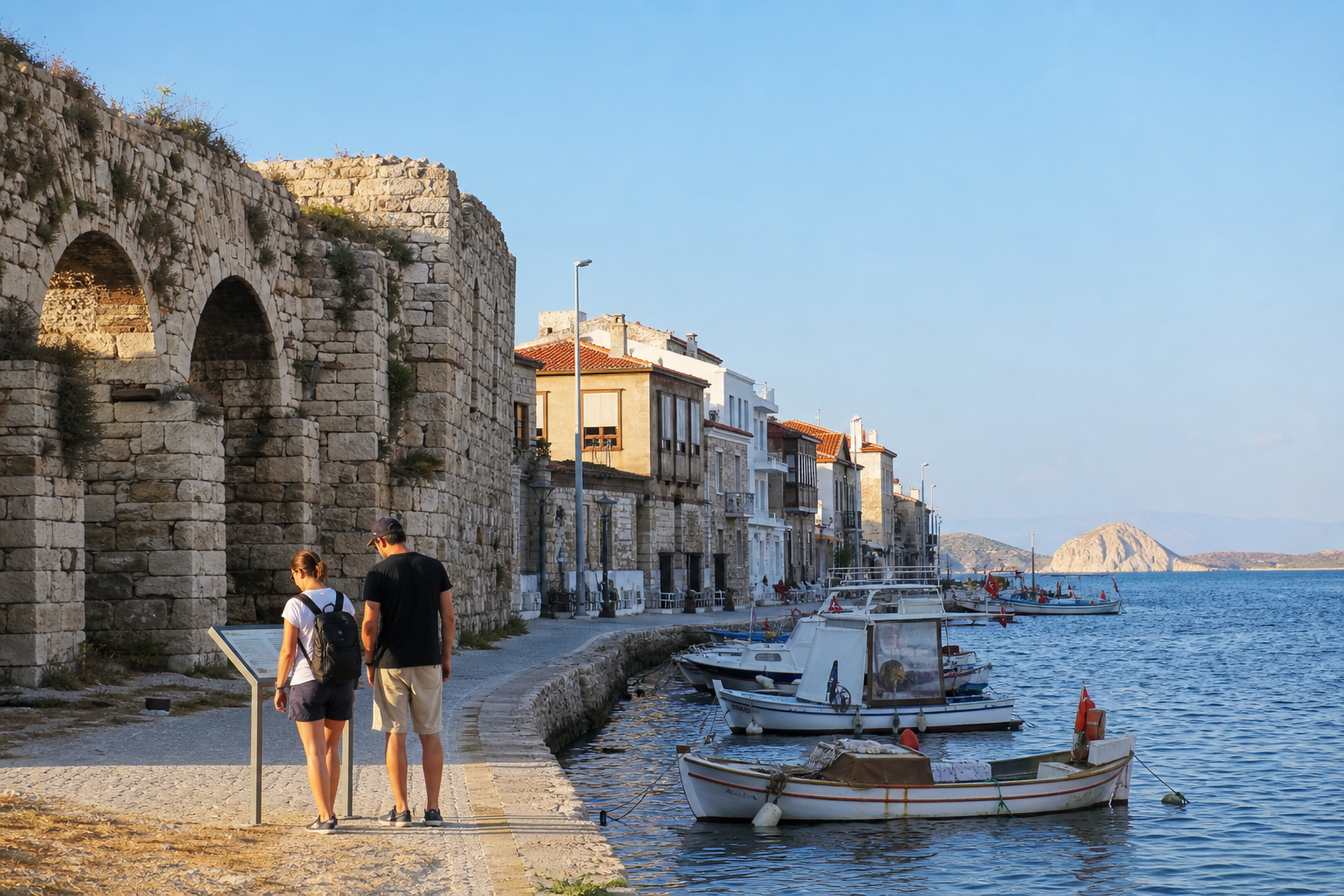
On the historic peninsula, Eski Foça is not a stop that can be cleanly separated into a town walk, a heritage visit and a coastal outing. Modern Foça stands above ancient Phokaia, while the water beyond its harbour lies within a protected coastal system with firm limits on use. That combination makes Eski Foça from İzmir better suited to a full, deliberately paced day than to an attempt to compress a beach, an island excursion and a historic centre into one hurried itinerary.
Foça is about 70 kilometres from İzmir, but distance alone does not determine the shape of the visit. Its Special Environmental Protection Area covers 227 square kilometres, and that designation has direct consequences for people considering time on the water. A car-free transfer is available, though it requires a connection, while offshore activities need checking rather than being treated as a standard coastal add-on.
Why the place matters now
Foça is divided between Old and New Foça, and the distinction matters for a day-trip plan. Eski Foça is the district’s preserved historic part, where the harbour setting and urban fabric form the central experience. Yeni Foça is more recently developed and largely summer-oriented. They belong to the same district, but they should not be approached as interchangeable versions of the same destination.
For a single day, Eski Foça rewards visitors who want the historic walk and harbour heritage to set the pace. Yeni Foça calls for a separate itinerary shaped by its seasonal settlement pattern. Trying to treat both as automatic stops can turn the historic peninsula into a short diversion between coastal activities, rather than allowing time for the relationship between its streets, waterfront and protected surroundings to become clear.
Historical development and turning points
Modern Foça occupies the site of ancient Phokaia, whose documented occupation extends from prehistoric times through the Archaic, Classical, Hellenistic, Roman, Byzantine, Genoese and Ottoman periods. This is more than a long list of eras. The contemporary settlement was formed through successive phases of occupation, repair and reuse, rather than being preserved as an archaeological site detached from everyday urban life.
Research on Phokaia’s urban archaeology records excavations undertaken intermittently from the early twentieth century, with a third major period continuing since 1989. Archaeology beneath an inhabited town changes the meaning of an ordinary street walk: the streets are part of the heritage encounter, and preservation becomes an urban-management question as well as an archaeological one. In Eski Foça, daily life and the historic record occupy the same physical ground.
How Beşkapılar explains the urban role
Beşkapılar offers a concentrated example of that continuity. It was the boat-house section of the Ottoman castle, repaired after 1455 and again in 1538–39, then restored in 1983 and 1994. Those recorded interventions matter because they show a structure repeatedly maintained and adapted over time, not an untouched Ottoman relic that has simply survived outside the life of the town.
Today, Foça Municipality presents Beşkapılar Castle and its open-air theatre as a venue for festivals, concerts, theatre and film events. The move from Ottoman boat-house to actively programmed cultural venue is a practical way to read the peninsula: heritage remains in use within a living town. Event dates and admission conditions should be checked against a current municipal calendar, because the available material does not establish a continuous programme or standing entry arrangement.
How the coast is managed
The wider protection area is an important habitat for the endangered Mediterranean monk seal, according to the official Foça Special Environmental Protection Area record. This status is not a broad environmental label attached to an otherwise unrestricted shoreline. Entry to caves used by seals is prohibited. Boat touring, diving and fishing at Siren Rocks are also prohibited, as is camping on Orak Island.
That makes an offshore itinerary around Siren Rocks something to question closely before committing to it. Scenic water and explicit conservation restrictions can overlap, so sightseeing should not be presumed permissible merely because it is offered or described as a boat outing. In specified parts of Büyükdeniz and Küçükdeniz harbours, a Harbour Master notice sets a 3-knot speed limit. The harbour is therefore a managed waterfront, while offshore sites carry their own more specific restrictions.
Access, surroundings and the right day-trip choice
Eski Foça from İzmir can be reached without a car through the route identified by the district administration: take İZBAN to Hatundere or Biçerova, then connect to an ESHOT bus for Foça or Yeni Foça. The official transport page describes reciprocal İzmir–Foça buses at roughly half-hour intervals, but it does not provide a dated passenger timetable. Check live departures on the travel day, and do not build the plan around an unverified transfer duration or fare.
The most defensible one-day choice is to make the historic harbour core and its streets the fixed part of the visit, then decide whether conditions and time support one water-based activity. In practice, choose rather than stack: pair the town walk with swimming, or pair it with a boat outing that complies with protected-area rules. The available evidence does not verify beach facilities, water quality, swimming safety, accessibility conditions or a list of licensed boat operators, so none of those should be assumed in advance.
Near-term changes and consequences
Coastal management is not confined to a line between land and sea. A completed conservation-NGO project integrated marine and coastal areas into a revised management-plan process under ministry coordination. Its significance is organisational: the shoreline, offshore environment and the activities affecting them are being addressed within one management process, rather than as entirely separate landscapes.
The environment authority oversees the protection area, while local bodies publish the transport, seal-use and harbour rules that affect a visitor’s choices. Research on Foça has identified tension between coastal tourism, second homes and conservation across natural, rural and urban spaces. That trade-off gives a slower visit practical value, but it does not confirm any particular future rule, beach opening or boat arrangement. Check weather, live transport and water-activity conditions before leaving İzmir; the strongest day here gives equal weight to the town’s layered history and its regulated coast.
Sources
- foca.gov.tr
- dergipark.org.tr
- Foça Özel Çevre Koruma Bölgesi
- About Visit Izmir
- Kent İçi Arkeolojik Alanlarda Katmanlaşmanın Analizi ve Koruma Sorunları: Foça Örneği | April 2018, Volume 82 – Issue 293 | Belleten
- T.C. Foça Kaymakamlığı – Beş Kapılar Kalesi
- Beşkapılar Kalesi ve Açık Hava Tiyatrosu – Foça Belediyesi Kültür Portalı
- T.C. Foça Kaymakamlığı – Foça'nın Foku
- DENİZCİLERE DUYURU – – Foça Liman Başkanlığı
- Akdeniz Koruma Derneği